
A fingernail lost to an injury takes about six months to grow back, and a toenail can take up to 18 months, according to the NHS. That slow regrowth is a good reason to look after the nails you already have. Good nail care does not need a drawer full of products. A small kit and a few gentle habits will keep most adult nails clean, short and smooth, as long as you know when to stop.
No routine or product is perfectly safe for every person, because allergies, skin conditions, diabetes and existing nail problems all change what makes sense. This guide covers everyday nail care at home for adults. It does not cover infections, painful ingrown nails, nail disease or babies' nails.
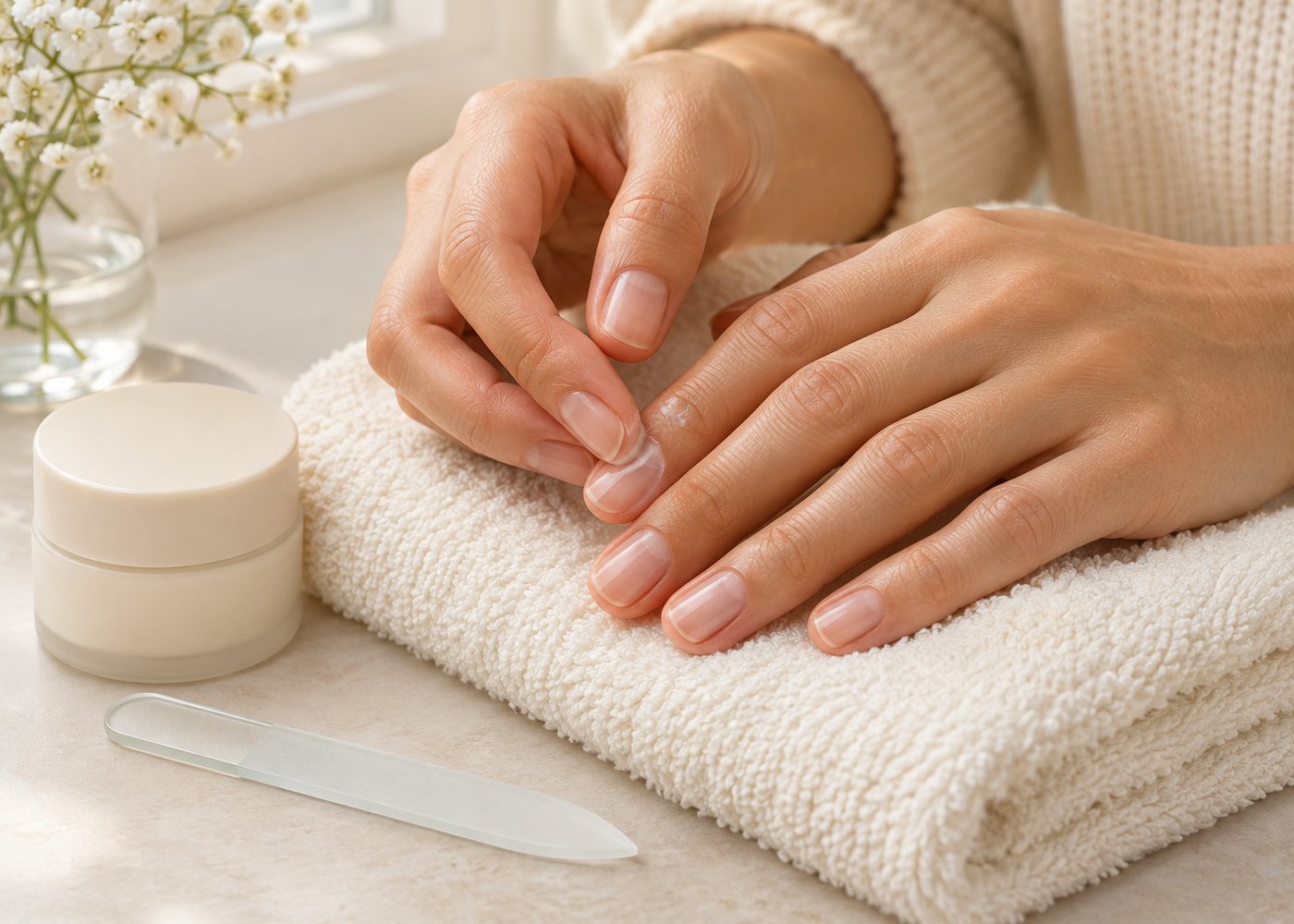
A small kit covers basic nail care
By the end of this routine you should have clean, smoothly trimmed nails with the skin around them left whole. Here is what you need:
- Soap, water and a soft nailbrush
- Fingernail clippers or small nail scissors for your fingers
- Toenail clippers for your toes
- A nail file or emery board
- Ordinary hand lotion
- Cotton-lined rubber gloves for chores
- A small brush and 70 to 90 percent isopropyl alcohol for cleaning tools once a month
You do not need a cuticle pusher, cuticle oil, a branded serum, polish or a salon visit for healthy nails. Mayo Clinic notes that rubbing regular hand lotion into your nails and cuticles does the moisturizing job. If you are unsure which lotion to choose, our guide to the benefits and risks of moisturizers explains what to look for.
Follow your nail care routine in six steps
Nails are made of keratin, a tough protein, and they grow out from the base toward the tip. The steps below work with that growth instead of fighting it.
1. Inspect your nails first. Skin around a nail that is sore, red, swollen and warm can mean paronychia, an infection around the nail, and the NHS advises seeing a doctor. A nail that is lifting, a new or changing dark streak, or an unexplained change in shape or colour also needs a professional, so leave that nail alone until it has been checked. Plenty of differences are normal, though. Vertical ridges often become more visible with age, small white marks from a knock grow out with the nail, and brown lengthwise bands on several nails can be normal in people with skin of colour. Melanoma is one possible cause of a dark streak, which is why a new or changing one deserves a dermatologist's assessment.
2. Clean your tools. Wash your clippers and file before each use. Once a month, disinfect them as well: scrub clippers or scissors with a small brush soaked in alcohol, rinse with hot water and let them dry completely before you put them away.
3. Wash your hands and clean under your nails. Dirt and germs collect under nails, so use soap and water or a soft nailbrush during handwashing. Avoid sharp objects here, because digging with a pointed tool can injure the nail and is one of the causes of a nail lifting away from the skin.
4. Trim nails once they are soft. Nails cut more cleanly after a bath or shower, or after a short dip in lukewarm water. Keep the dip brief, because too much water weakens nails rather than strengthening them. Clip fingernails almost straight across, and clip toenails straight across to help prevent ingrown nails. If you have a hangnail, which is a small loose piece of dry skin, clip just the loose piece with clean tools. Pulling or biting it can tear the healthy skin next to it.
5. File the rough edges. Smooth each edge by filing in one direction instead of sawing back and forth. Round fingernail corners slightly so they do not catch on clothes, but leave toenail corners straight.
6. Moisturize and leave your cuticles alone. Rub lotion into your nails and the skin around them, then stop. Your cuticle is a seal, and cutting or pushing it back can let in germs, irritants and allergens. Having a professional trim it instead does not remove that risk.
Daily habits keep healthy nails strong
Most nail damage happens between trims. Repeated or long contact with water can split nails, so wear cotton-lined rubber gloves when you wash dishes, clean or handle harsh chemicals. Moisturize after you wash your hands, because frequent wetting can lead to peeling, splitting and breakage. And stop using your nails as tools, since opening cans or prying lids can chip, split or lift a nail.
Toenails need their own approach
Toenails grow more slowly than fingernails, so they need trimming less often. Always cut them straight across. If they are too thick or tough to cut, or you cannot reach your feet comfortably, the NHS recommends seeing a podiatrist, a foot care specialist. Never dig out an ingrown toenail yourself, especially one that is sore or infected. That needs professional treatment.
Diabetes changes the foot steps
If you have diabetes, nerve damage can stop you from feeling a cut or blister on your foot. The CDC advises checking your feet every day, even when they feel fine. Several steps above also change for you:
- Wash your feet in warm water, not hot, and do not soak them. Skip the softening dip for toenails.
- Dry your feet well and keep lotion out of the spaces between your toes.
- Trim toenails straight across. If you cannot see or reach your feet, have a podiatrist do it.
- Get medical care quickly for a blister, sore, ulcer, infected corn or ingrown toenail. Do not wait for your next scheduled appointment.
Polish, gel and supplements are optional
You can have healthy nails without ever wearing polish. If you enjoy it, the main safety rules come from the product label. The FDA advises following the directions and warnings, working in a room with fresh air and remembering that some nail products can catch fire or cause harm if swallowed or splashed in the eyes. A label that says "natural" or "clean" does not promise that a product cannot irritate your skin or cause an allergy.
Nails do not need a polish break to breathe. As an Ohio State dermatologist has explained, nails do not take in air through their surface. Still, skip polish and artificial nails when a nail is damaged, cracked or possibly infected, or when the cuticle area is red or inflamed.
Gel and acrylic manicures carry more risk. They can damage the nail, loosen it from the skin, cause infection around the nail and trigger irritation or allergic rashes. Chemicals called methacrylates in artificial nail products can cause allergies, so avoid getting them on your skin. If you have repeated nail problems or an acetone allergy, regular polish may suit you better, since acetone is used to remove gel.
Before gel curing, the AAD suggests a water-resistant, broad-spectrum sunscreen of SPF 30 or higher on your hands, or dark gloves with the fingertips cut out. That lowers ultraviolet exposure but does not make the process free of risk. When gel starts to lift, resist peeling it off, because professional removal is gentler on the nail.
Be careful with quick fixes for brittle nails. Using nail hardeners that contain formaldehyde often can make nails more brittle and more likely to peel or break, and these products can cause irritation or allergy. Biotin supplements are popular too, but the NIH Office of Dietary Supplements says the evidence for nail benefits is limited. High doses can also distort some lab results, including certain thyroid tests, so tell your doctor about any supplements before blood work.
Check your results before you finish
Run a fingertip along each nail edge. It should feel smooth and should not snag on a cotton cloth. Look at the skin around each nail: the cuticles should be in place, with no torn edges or raw patches. Toenails should be straight across with no sharp spurs left at the corners.
If anything hurts or bleeds, stop working on that nail, because you have cut too close or caught the skin. If the area later turns red, swollen or warm, see a doctor. For the full trimming method, the American Academy of Dermatology's guide to trimming nails is a reliable reference to keep handy.
Frequently Asked Questions
I just quit biting my nails. Where should I start?
Start with steps 3 to 6. Keep your nails short, clean under them when you wash your hands, file rough edges in one direction and moisturize daily. Clip hangnails with clean clippers rather than pulling them, since torn skin is easy to pick at again.
How long until my nails look better?
There is no fixed timetable. Smoother edges show up as soon as you file, but damaged nail has to grow out completely, which takes months for fingernails and longer for toenails.
Why does my polish peel off after a shower?
There is no single cause, so be wary of anyone offering one universal fix. What you can control is water exposure: gloves for chores and lotion after washing help protect the nail underneath. If peeling comes with redness, cracking or nail damage, give polish a rest until the nail has been checked.
How often should I trim my nails?
Trim whenever your nails pass the length you like instead of following a set calendar. Fingernails grow faster, so they need attention more often than toenails do.
If you wish to contribute to our blog, please email us on info@newyorktimeswordle.net.